
 admin

The research peptide market has grown considerably as scientific interest in amino acid sequences, cellular processes and molecular biology continues to develop. Alongside this growth, more suppliers have entered the market, making it increasingly important to understand where products come from, how they are tested and whether quality claims can be independently verified.
True Peptides is one name that appears in this expanding marketplace. The supplier’s website, true-peptides.com, presents itself as a source of research-grade peptides, highlighting third-party laboratory testing, batch verification and Certificates of Analysis (COAs).
However, impressive website claims are only one part of evaluating a research supplier. Understanding the difference between advertised purity, independently documented results and regulatory approval is equally important.
This article examines True Peptides, its publicly presented services, product range, quality claims and the considerations that matter when assessing a research peptide supplier.
What Is True Peptides?
True Peptides is an online supplier that markets research compounds intended for laboratory and analytical applications. Its website focuses on peptide products and presents quality verification as a central part of its business model.
According to its published information, the company emphasizes several quality-related features:
- High-purity research compounds.
- Independent laboratory testing.
- High-performance liquid chromatography (HPLC) analysis.
- Mass spectrometry testing.
- Batch identification and traceability.
- Certificates of Analysis for individual products.
The website also states that its products are intended exclusively for laboratory research and are not approved for human or veterinary use. True Peptides+1
This distinction is important because research chemicals are not automatically equivalent to approved medicines. A compound can be useful in laboratory investigations without having established safety or effectiveness for medical treatment.
It is also worth distinguishing similarly named businesses. True Peptides at true-peptides.com is not automatically the same company as True Peptides at truepeptides.co, True Peptides at truepeptides.net or True Peptide Labs. Their websites and business information should be evaluated separately.
Understanding the True Peptides Product Range
True Peptides presents a catalogue covering several categories of research compounds. These include peptides associated with tissue biology, metabolic research, cellular processes and other areas of scientific investigation.
Some examples displayed on its website include the following.
BPC-157
BPC-157 is a synthetic peptide frequently discussed in experimental research involving tissue biology and cellular processes.
Much of the interest surrounding this compound comes from preclinical research. However, promising laboratory findings do not establish that it is safe or effective as a treatment for people.
The FDA has highlighted concerns regarding the safety information available for BPC-157, including potential immunogenicity and peptide-related impurities. FDA+1
TB-500
TB-500 is associated with research discussions involving thymosin beta-related compounds and biological processes.
Researchers investigate different aspects of peptide activity, but it is important to distinguish experimental findings from established clinical evidence.
The availability of a product from a research supplier does not establish that it has been approved for medical treatment.
GHK-Cu
GHK-Cu is a copper-binding peptide that has attracted scientific interest in connection with skin biology, cellular signalling and related research areas.
Its biological properties make it an interesting subject for laboratory investigation. Nevertheless, research findings should not be interpreted as proof that every commercially available GHK-Cu product provides a particular health or cosmetic benefit.
Metabolic Research Compounds
The True Peptides catalogue also displays compounds associated with metabolic research, including GLP-related products and other experimental molecules.
These compounds belong to an area of scientific research that continues to develop. Their individual regulatory status, available clinical evidence and safety profiles can differ significantly.
Researchers should therefore evaluate each compound separately instead of assuming that all peptides have the same applications or evidence base.True Peptides+1
How Does True Peptides Approach Product Quality?
Product quality is one of the most important considerations in the research peptide industry.
Peptides are chemically specific molecules, and their identity, purity and composition can influence the reliability of experimental results. A supplier’s quality claims should therefore be supported by appropriate analytical documentation.
True Peptides advertises several quality-control features on its website.
1. HPLC Testing
High-performance liquid chromatography is an analytical technique used to separate components within a sample.
In peptide analysis, HPLC can help assess purity by identifying and measuring the relative presence of different components.
For example, a chromatogram may show the primary peptide peak alongside smaller peaks representing other detectable substances.
However, an HPLC purity percentage does not automatically establish the identity, safety or overall quality of a compound. Results depend on the analytical method, reference standards and interpretation.
2. Mass Spectrometry
Mass spectrometry provides information about the mass-to-charge ratio of ions.
In peptide research, this technique can help assess whether a sample’s measured molecular mass corresponds with the expected compound.
Combining mass spectrometry with HPLC can provide more useful analytical information than relying on a single measurement.
Nevertheless, neither technique independently establishes that a research compound is suitable for human administration.
3. Batch-Specific Documentation
Another feature highlighted by True Peptides is batch verification.
A batch number connects a particular product to its manufacturing or testing records. This makes documentation easier to assess and helps distinguish one production batch from another.
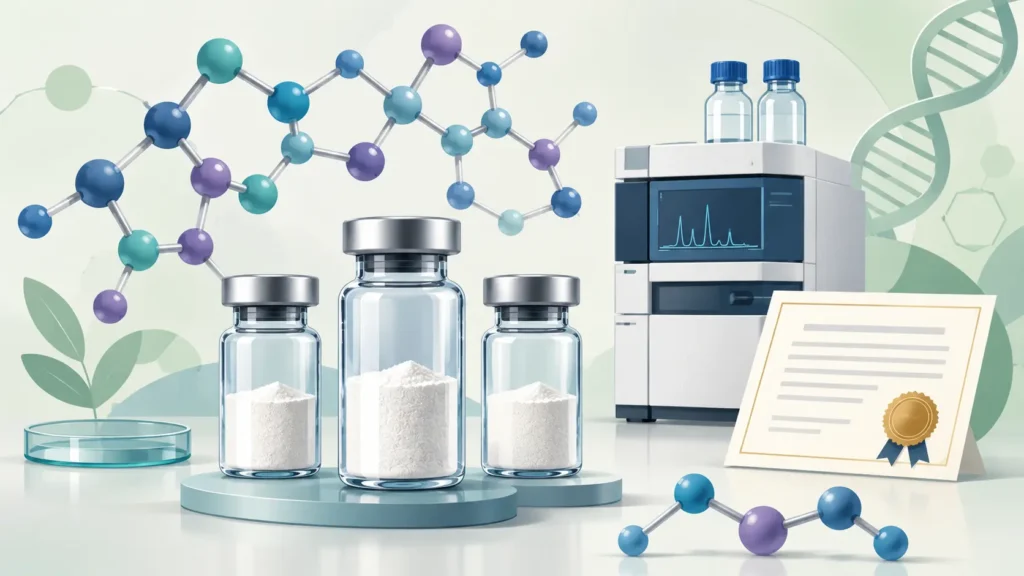
The supplier advertises Certificates of Analysis and individual batch identification as part of its quality approach. True Peptides+1
For meaningful verification, the documentation should identify the actual compound, relevant batch number, analytical methods, results and testing laboratory.
What Is a Certificate of Analysis and Why Does It Matter?
A Certificate of Analysis, commonly called a COA, is a document that reports analytical results for a particular material or batch.
In the peptide industry, it can help researchers understand what testing has been performed and what the laboratory reported.
A useful COA should contain several important details:
- Product identification: The name and identity of the compound being examined.
- Batch information: A unique identifier connecting the report to a specific batch.
- Purity results: Analytical findings showing the measured purity.
- Testing methods: Information about the techniques used for analysis.
- Laboratory details: The identity of the laboratory responsible for the testing.
- Testing date: When the analysis was performed.
One particularly important consideration is whether a COA genuinely belongs to the product being advertised.
A generic report, an outdated certificate or a document for another batch provides limited assurance about the material under consideration.
True Peptides advertises publicly accessible batch documentation. However, readers should distinguish the availability of a certificate from independent confirmation that every result is authentic and accurately represents the delivered product.
A report should be checked against its laboratory, batch identifier and analytical details rather than accepted solely because it appears on a supplier’s website.
Is True Peptides Legitimate?
This is an important question for anyone researching the company.
The presence of a professional website, detailed product descriptions and published quality claims does not independently establish a supplier’s legitimacy.
True Peptides at true-peptides.com presents itself as a research-focused supplier and publishes information about laboratory testing and product documentation.
However, independent assessments available online do not provide a completely consistent picture.
For example, Peptide Referee published a transparency assessment that identified limitations in the available public verification information. Other vendor-review publications have reported more favourable findings concerning its laboratory documentation. These assessments use different methodologies and should not be treated as definitive proof of product quality. Peptide Referee+2
There are several questions worth considering:
Is the business identity independently verifiable?
A transparent supplier should make it reasonably straightforward to identify the legal business, its operating location and its contact information.
Are laboratory reports traceable?
A certificate should contain enough information to connect the tested material with the specific product batch.
Are independent reviews available?
Customer reviews can provide useful information about communication, delivery and customer experiences. However, they cannot replace laboratory analysis.
Are quality claims supported by evidence?
Statements such as 99% purity and third-party verified should be supported by relevant documentation.
Based on the available information, True Peptides publishes several quality-related claims, but those claims should not automatically be interpreted as independently established guarantees.
Why Third-Party Testing Matters in Peptide Research
Third-party testing involves an analytical laboratory examining a sample independently of the supplier.
This approach can add another level of transparency because the testing organisation is separate from the business selling the material.
It is particularly relevant in research environments where experimental accuracy matters.
For instance, a researcher studying a particular peptide needs confidence that the material being examined corresponds to the intended compound.
If the sample contains unexpected impurities or has been incorrectly identified, the results of an experiment may become difficult to interpret.
Independent testing can help address some of these concerns.
However, the phrase third-party tested is not enough by itself. The laboratory’s identity, analytical capabilities, testing methods and report authenticity all deserve attention.
Researchers should also understand that a high purity result does not necessarily confirm sterility, endotoxin levels, stability or suitability for a particular experimental application.
Different quality characteristics require different tests.
Research Peptides and Regulatory Considerations
An important issue surrounding True Peptides and similar suppliers is the distinction between laboratory materials and approved medical products.
A compound advertised for research use does not automatically become a medicine simply because it is associated with a biological process.
In the United States, the Food and Drug Administration (FDA) regulates medicines and has specific requirements concerning drug approval and compounding.
The FDA explains that compounded drugs are not FDA-approved and are not subject to the same premarket review of safety, effectiveness and quality as approved medicines. FDA+1
The agency has also raised concerns about certain unapproved peptide products marketed with research-only disclaimers despite evidence suggesting that they are intended for human use. FDA+1
These distinctions matter because laboratory research and medical treatment have different requirements.
A research supplier’s disclaimer should be taken seriously. Products labelled for laboratory research should not be treated as medicines or used for self-experimentation.
Regulatory requirements also differ between countries. Anyone working with research compounds should understand the relevant local rules before obtaining or handling them.
What Should Researchers Consider When Evaluating True Peptides?
Evaluating a peptide supplier requires more than comparing catalogue sizes or advertised purity percentages.
Several practical factors can help create a clearer picture.
Review the Available Documentation
Look for product-specific and batch-specific analytical reports.
Check whether the compound name, testing date, laboratory and analytical results are clearly presented.
Examine Testing Methods
Different analytical methods provide different types of information.
HPLC can help assess purity, while mass spectrometry can support molecular identification.
A comprehensive quality assessment may require additional analytical procedures depending on the material.
Check Business Transparency
Review the supplier’s published business information, contact details and policies.
Clear information makes it easier to understand who operates the website and where questions or concerns should be directed.
Separate Reviews From Scientific Evidence
Customer feedback can help identify recurring service issues, but positive experiences do not establish molecular identity or purity.
Scientific documentation and customer-service reputation are separate considerations.
Understand the Intended Research Application
Every compound has its own research background, limitations and regulatory considerations.
Researchers should consult relevant scientific literature and institutional requirements rather than relying entirely on product descriptions.
Frequently Asked Questions About True Peptides
Is True Peptides a research peptide supplier?
Yes. The website true-peptides.com describes True Peptides as a supplier of research compounds intended for laboratory and analytical applications.
Does True Peptides advertise third-party testing?
Yes. Its website advertises independent laboratory testing, including HPLC and mass spectrometry, alongside batch-related Certificates of Analysis. These are supplier-published claims and should be verified through the relevant documentation.
What is the purpose of a peptide Certificate of Analysis?
A COA provides analytical information about a particular product or batch. It can include compound identification, purity results, testing methods and laboratory details.
Are True Peptides products approved for human consumption?
The true-peptides.com website states that its products are intended for laboratory research only, not human or veterinary use. They should not be treated as approved medicines.
How can researchers evaluate peptide quality?
Researchers can examine batch-specific documentation, analytical methods, laboratory information, molecular identification and relevant quality-control records. No single purity percentage establishes every aspect of product quality.
Conclusion
True Peptides is a name worth examining within the expanding research peptide marketplace, particularly because its website places significant emphasis on analytical testing, batch verification and documentation.
Its published information provides an overview of its product categories and stated quality-control approach. However, responsible evaluation requires looking beyond marketing claims and examining the evidence behind them.
For researchers, the most important considerations include traceable batch documentation, reliable analytical methods, transparent business information and a clear understanding of regulatory requirements.
Ultimately, True Peptides should be evaluated on verifiable evidence rather than advertised promises. Careful documentation and independent assessment remain essential when researching any supplier in the peptide industry.
8. Frequently Asked Questions
1. What is True Peptides?
True Peptides is an online supplier that markets research-grade peptides and laboratory compounds.
2. Does True Peptides provide COAs?
Its website advertises batch-specific Certificates of Analysis and laboratory testing documentation.
3. What testing methods does True Peptides mention?
The website mentions HPLC and mass spectrometry for peptide quality assessment.
4. Are True Peptides products intended for medical use?
No. The supplier states that its products are intended for laboratory research and are not for human or veterinary consumption.
5. Why is peptide purity testing important?
Purity testing helps identify the composition of a sample and provides useful information for evaluating its suitability for a particular research investigation.