
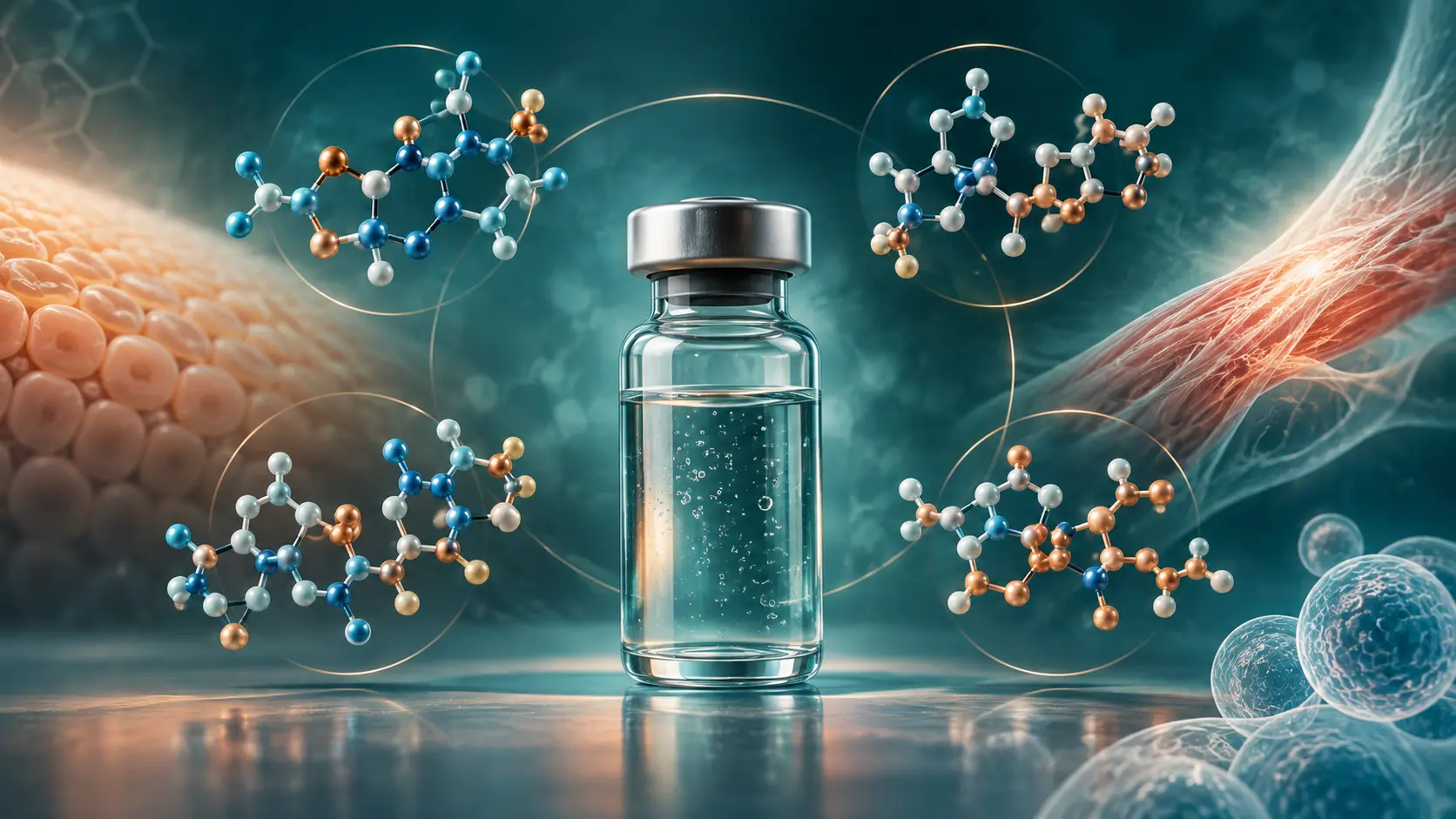
KLOW peptide has become a topic of interest in the growing world of peptide research, particularly among people exploring tissue repair, skin health, inflammation and physical recovery. Its popularity comes from an unusual combination of four different peptides, each associated with separate areas of scientific investigation.
However, there is an important distinction between what a product is advertised to do and what researchers have actually demonstrated. Although individual ingredients have attracted scientific attention, the complete KLOW formulation has not established its effectiveness through controlled clinical trials.
Understanding its ingredients, potential applications and limitations is essential before accepting the claims surrounding it.
What Is KLOW Peptide?
KLOW peptide is a multi-peptide formulation containing four separate compounds:
- GHK-Cu
- BPC-157
- TB-500
- KPV
It is generally marketed as a research peptide blend associated with tissue repair, recovery, skin health and inflammatory responses.
Unlike a conventional peptide with one defined molecular structure, KLOW is a product name used for a combination of different peptides. The name does not describe a naturally occurring molecule or a single scientifically established drug.
Some suppliers advertise an 80 mg formulation containing:
| Ingredient | Commonly listed amount |
|---|---|
| GHK-Cu | 50 mg |
| BPC-157 | 10 mg |
| TB-500 | 10 mg |
| KPV | 10 mg |
| Total | 80 mg |
These amounts represent a commonly advertised formulation, not a universal standard. Different manufacturers may use different compositions, and a product label does not independently confirm what a vial contains.
This distinction matters because the scientific evidence for each ingredient is different.
Understanding the Four Ingredients in KLOW
The main reason KLOW attracts attention is that its ingredients are associated with different biological processes. Examining them individually provides a clearer picture of what researchers are investigating.
1. GHK-Cu: The Copper Peptide
GHK-Cu is a copper-binding tripeptide made from three amino acids: glycine, histidine and lysine.
It has received attention in skin research because of its involvement in processes related to collagen, extracellular matrix remodelling and cellular responses.
Collagen is an important structural protein that helps maintain the strength and organisation of skin and other connective tissues.
Researchers have investigated GHK-Cu for several possible applications, including:
- Skin appearance and texture.
- Collagen-related activity.
- Wound-healing processes.
- Cellular repair mechanisms.
- Inflammatory responses.
Some research has explored its use in topical skincare products. However, findings from creams cannot automatically be applied to injectable formulations.
A 2006 clinical study involving 13 patients examined topical copper tripeptide products following carbon dioxide laser resurfacing. The researchers found no significant improvement in several objective skin measurements compared with the control treatment, although patient satisfaction differed between groups. PubMed+1
This demonstrates why promising laboratory findings should not be confused with established clinical results.
2. BPC-157: A Peptide Studied for Tissue Repair
BPC-157 is a synthetic peptide consisting of 15 amino acids. It is associated with research into biological repair processes, particularly involving tendons, muscles, ligaments and the digestive system.
Much of the interest comes from animal experiments investigating how this compound interacts with tissue responses after injury.
Researchers have explored its possible relationship with:
- Tendon and ligament repair.
- Gastrointestinal tissue.
- Blood vessel formation.
- Inflammatory signalling.
- Cellular responses following injury.
Some animal studies have reported encouraging findings involving tendon healing. Nevertheless, animal results cannot establish that the same outcomes will occur in humans.
Human evidence remains extremely limited.
The US Food and Drug Administration (FDA) has also identified concerns involving compounded products containing BPC-157. These include potential immunogenicity, peptide impurities and insufficient safety information for proposed administration routes. FDA+1
Consequently, BPC-157 should not be treated as an established treatment for sports injuries or other medical conditions.
3. TB-500: Research Into Cellular Movement and Repair
TB-500 is commonly associated with thymosin beta-4 research. It is a synthetic peptide fragment related to this naturally occurring protein.
Thymosin beta-4 has been investigated for its involvement in cellular movement, tissue responses and wound-healing processes.
These biological functions have made the wider research area interesting to scientists studying tissue recovery.
Research involving thymosin beta-4 has explored:
- Cell migration.
- Wound-healing processes.
- Tissue regeneration.
- Inflammatory responses.
- Cellular organisation.
However, TB-500 and full-length thymosin beta-4 should not be treated as interchangeable substances.
Evidence involving the complete thymosin beta-4 protein does not automatically demonstrate that a shorter fragment will produce the same effects.
The FDA’s assessment of TB-500-related substances has highlighted limited effectiveness data and concerns about peptide impurities and potential immune reactions, particularly with injectable formulations. U.S. Food and Drug Administration+1
For this reason, claims that TB-500 reliably accelerates human injury recovery remain unproven.
4. KPV: A Peptide Investigated for Inflammation
KPV stands for lysine-proline-valine. It is a short tripeptide associated with alpha-melanocyte-stimulating hormone research.
Its main research interest involves inflammatory signalling, particularly in studies examining intestinal inflammation.
A study published in 2007 investigated KPV in laboratory cells and mouse models of intestinal inflammation. Researchers observed changes in inflammatory signalling pathways and reported reduced inflammatory responses in the experimental models. PubMed+1
These findings help explain why KPV is included in formulations marketed around inflammatory responses.
Nevertheless, experiments involving cells and mice do not establish that KPV treats inflammatory diseases in humans.
More clinical research is needed to understand its effectiveness, appropriate delivery methods and safety.
What Are the Potential Benefits of KLOW Peptide?
KLOW is promoted around several possible benefits. Most of these claims come from research involving its individual ingredients rather than studies of the complete blend.
Understanding that difference helps readers separate scientific possibilities from marketing statements.
Skin Health and Collagen Research
GHK-Cu is the ingredient most closely associated with cosmetic and skin-related research.
Scientists have investigated its relationship with collagen production, skin structure and cellular activity.
This has created interest in its potential applications in skincare and cosmetic formulations.
However, the available evidence does not establish that injecting or using the complete KLOW blend improves skin quality, reduces wrinkles or produces predictable cosmetic results.
Tissue Repair and Physical Recovery
BPC-157 and thymosin beta-4-related research has attracted attention in discussions about tendons, ligaments and other tissues.
The underlying scientific interest involves how cells respond to injury and how biological repair processes develop.
Although animal studies provide some interesting findings, there is not enough reliable human evidence to conclude that KLOW improves recovery after exercise, sports injuries or surgery.
Inflammatory Response Research
KPV has been investigated for its potential effects on inflammatory pathways.
GHK-Cu and the other ingredients have also been studied in different biological contexts involving inflammation and tissue responses.
However, combining these ingredients does not automatically create a more effective treatment. Their interactions, combined effects and possible unwanted reactions require independent investigation.
General Recovery and Wellness Claims
Some online discussions associate KLOW with improved physical performance, reduced discomfort and general recovery.
These claims should be approached carefully.
There is no established clinical evidence showing that the complete KLOW formulation improves athletic performance, increases strength or provides general wellness benefits.
At present, these remain proposed applications rather than proven outcomes.
What Does Scientific Research Actually Say?
One of the biggest questions surrounding KLOW peptide is whether the complete formulation has been scientifically tested.
The distinction between ingredient research and combination research is particularly important.
Researchers may study one peptide under controlled conditions, but that does not demonstrate that four different compounds will work safely or effectively when combined.
As of November 2026, the available evidence does not establish clinical effectiveness for the complete KLOW blend.
The research landscape can be summarised as follows:
| Research area | Current evidence |
|---|---|
| GHK-Cu and skin | Some human research, mostly limited topical studies |
| BPC-157 and tissue repair | Predominantly preclinical research |
| TB-500 and recovery | Limited evidence for the specific fragment |
| KPV and inflammation | Laboratory and animal research |
| Complete KLOW blend | No established clinical effectiveness |
This does not mean every ingredient lacks scientific interest. It means that promising findings at an early research stage should not be presented as proven medical benefits.
For readers interested in the underlying science, PubMed provides access to published research on GHK-Cu, KPV and related compounds.
Is KLOW Peptide FDA Approved?
No. KLOW is not an FDA-approved medication.
It is generally marketed by suppliers as a research-use peptide blend rather than an approved treatment for a medical condition.
The FDA has raised safety concerns about several peptide substances used in compounded products. Its assessments discuss issues such as:
- Potential immune reactions.
- Peptide impurities.
- Product aggregation.
- Insufficient human safety information.
- Uncertainty about particular administration routes.
For example, the agency has specifically identified concerns about BPC-157 and injectable GHK-Cu in its compounding safety assessments. Its evaluation of TB-500-related substances also highlights important evidence and quality-control limitations. FDA+2
It is important to understand that research-use labelling does not establish that a substance is safe for human consumption or injection.
Regulatory approval also differs between countries. The absence of FDA approval does not, by itself, describe every country’s legal position, but consumers should not assume that an online research product is an authorised medicine.
Possible Risks and Safety Concerns
Safety is one of the most important issues when evaluating KLOW.
Because the complete formulation has not been adequately studied in humans, there is no reliable clinical safety profile for the combination.
Several concerns deserve attention.
1. Unknown combined effects
Each ingredient has its own biological properties. Researchers have not established how all four interact when administered together.
2. Immune reactions
Some peptide formulations may cause immune responses. The FDA has highlighted potential immunogenicity concerns involving certain compounded peptides.
3. Product quality
Products sold online may differ in composition, purity and manufacturing standards. A supplier’s description is not proof of the actual contents.
4. Injection-related complications
Injectable products introduce additional concerns, including contamination, infection and reactions at the administration site.
5. Limited long-term information
There is insufficient evidence to establish the long-term effects of using the complete KLOW formulation.
Anyone considering a peptide product for a medical concern should discuss the issue with a qualified healthcare professional rather than relying on online claims or seller instructions.
KLOW Peptide vs GLOW Peptide: What Is the Difference?
KLOW and GLOW are two names that frequently appear in the research peptide market.
The commonly advertised distinction is the addition of KPV.
| Feature | KLOW | GLOW |
|---|---|---|
| GHK-Cu | Yes | Yes |
| BPC-157 | Yes | Yes |
| TB-500 | Yes | Yes |
| KPV | Yes | Usually not included |
| Formulation | Three shared ingredients plus KPV | Three-ingredient combination |
The exact quantities can vary between suppliers.
Neither name represents a universally standardised, clinically validated medicine. Therefore, comparing two products requires looking at their actual ingredient lists and documentation rather than relying on their marketing names.
What Should Readers Know Before Trusting KLOW Peptide Claims?
The peptide market contains a mixture of scientific information, commercial advertising and personal experiences.
A supplier might describe a formulation as a recovery solution, while social media discussions may present individual experiences as proof of effectiveness.
Neither type of claim replaces controlled clinical research.
Readers should consider several questions:
- Is the information supported by published scientific research?
- Was the study conducted in humans, animals or laboratory cells?
- Was the exact KLOW combination tested?
- Are the ingredients independently verified?
- Is the product authorised for the claimed medical use?
- Are possible risks explained alongside the advertised benefits?
These questions help distinguish reliable scientific information from unsupported promotional claims.
It is also worth remembering that a certificate of analysis, when available, may provide information about a tested batch’s identity or purity. It does not prove that a product is effective or safe for human use.
Conclusion: Is KLOW Peptide Worth the Attention?
KLOW peptide is an interesting example of how different research compounds are being combined and marketed within the growing peptide industry.
Its four ingredients, GHK-Cu, BPC-157, TB-500 and KPV, have attracted scientific interest in areas involving skin biology, tissue repair and inflammatory responses. Some early findings are promising, particularly in laboratory and animal research.
However, the complete formulation remains an important evidence gap. There is no established clinical proof that KLOW delivers the advertised benefits, and its combined safety profile has not been adequately established.
The most sensible approach is to look beyond marketing claims and examine the actual scientific evidence. Until better human research becomes available, KLOW should be understood as an experimental research blend rather than a proven treatment for recovery, skin health or inflammation.
8. Frequently Asked Questions
1. What is KLOW peptide?
KLOW is a research peptide blend containing four ingredients: GHK-Cu, BPC-157, TB-500 and KPV. It is marketed around tissue repair, skin health and recovery, but its clinical effectiveness has not been established.
2. What are the main ingredients in KLOW peptide?
The four commonly listed ingredients are GHK-Cu, BPC-157, TB-500 and KPV. Each has a separate research background and different biological properties.
3. Does KLOW peptide help with recovery?
There is no reliable clinical evidence establishing that the complete KLOW blend improves human recovery. Some individual ingredients have shown interesting results in laboratory and animal studies.
4. Is KLOW peptide FDA approved?
No. KLOW is not an FDA-approved medication. Products marketed for laboratory research should not be assumed to be suitable for human use.
5. What is the difference between KLOW and GLOW peptide?
The commonly advertised difference is that KLOW includes KPV alongside GHK-Cu, BPC-157 and TB-500. GLOW generally contains the other three ingredients without KPV.